Desmitificando la Esferificación
DOI:
https://doi.org/10.70221/rgc.v1i1.16Keywords:
Spherification, hydrocolloids, Agar agar, Alginates, Vanguardist cuisineAbstract
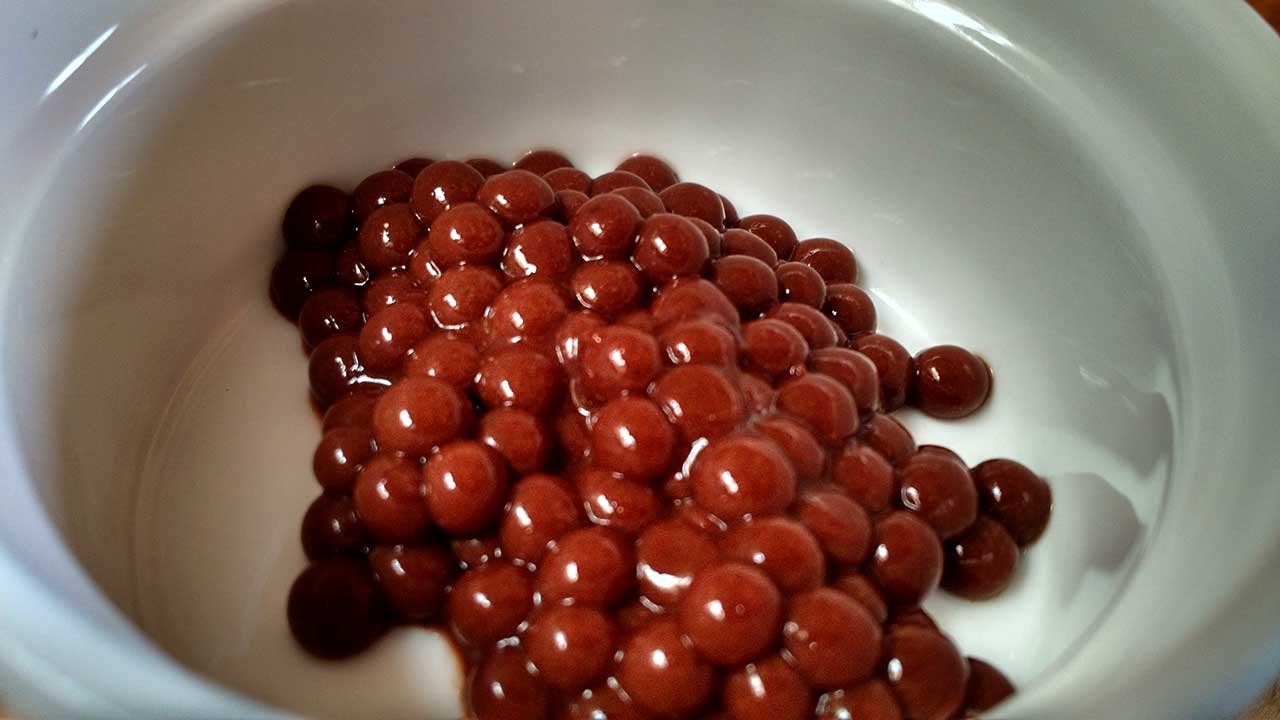
La esferificación es una de las técnicas más comunes de la llamada cocina molecular por lo vistosa que puede llegar a ser y porque tiene requerimientos de ingredientes y equipamiento muy modestos. Aun así, no existe una comprensión sólida del procedimiento y sus variables. La esferificación más difundida requiere alginato de sodio y una fuente de calcio, que forman un gel mediante un mecanismo de gelificación iónica. Esta gelificación requiere un pH superior a 3,6; razón por la cual es deseable tomar en cuenta la acidez de la base, o en su defecto contar con un regulador de acidez. La presencia de iones divalentes indeseables (calcio y magnesio principalmente) hacen deseable trabajar con agua filtrada. Controlar la viscosidad del líquido que se está esferificando es deseable para la producción y la sensación en boca: usualmente se utiliza xantana. Las esferificaciones más frecuentes son la directa y la inversa. De la esferificación inversa derivan la esferificación amoldada y la esferificación curada.
Downloads
References
Adrià, A., & Adrià, F. (2012). Sferificación. https://www.albertyferranadria.com/esp/texturas-sferificacion.html
Brenner, M. P., Sörensen, P. M., & Weitz, D. A. (2020). Science and cooking: Physics meets food, from homemade to haute cuisine (First edition). W.W. Norton & Company.
Burke, R. M., Kelly, A. L., Lavelle, C., & Kientza, H. T. vo (Eds.). (2021). Handbook of Molecular Gastronomy: Scientific Foundations, Educational Practices, and Culinary Applications (1a ed.). CRC Press. https://doi.org/10.1201/9780429168703 DOI: https://doi.org/10.1201/9780429168703
Castro, O., Xatruch, E., & Casañas, M. (2018). Pesto Multiesférico. Apicius, 1(31), 42.
ChefSteps. (2013). Chocolate Spheres | Recipe. https://www.chefsteps.com/activities/chocolate-spheres
Delgado, A. (2021). Los “huevos de oro” de Disfrutar: Castro, Xatruch y Casañas revolucionan las esferificaciones. ABC.ES. https://www.abc.es/gastronomia/madrid-fusion/abci-huevos-disfrutar-castro-xatruch-y-casanas-revolucionan-esferificaciones-202111160128_noticia.html
Gelb, D. (Director). (2016). Gaggan Anand (Vol. 2) [Series]. https://www.netflix.com/watch/80075154?trackId=255824129
Genestra, A. (2016). Cocarroi de cebolla caramelizada. Apicius, 1(26), 154.
Lee, P., & Rogers, M. A. (2012). Effect of calcium source and exposure-time on basic caviar spherification using sodium alginate. International Journal of Gastronomy and Food Science, 1(2), 96–100. https://doi.org/10.1016/j.ijgfs.2013.06.003 DOI: https://doi.org/10.1016/j.ijgfs.2013.06.003
Potter, J. (2010). Cooking for geeks: Real science, great hacks, and good food. O’Reilly.
Vega, C., Ubbink, J., Linden, E. van der, & Steingarten, J. (Eds.). (2013). The kitchen as laboratory: Reflections on the science of food and cooking. Columbia University Press. DOI: https://doi.org/10.7312/columbia/9780231153454.001.0001
Downloads
Published
Issue
Section
License
Copyright (c) 2022 Rodrigo Duarte, Marlene Rojas Le-Fort

This work is licensed under a Creative Commons Attribution 4.0 International License.
You are free to:
Share — copy and redistribute the material in any medium or format
Adapt — remix, transform, and build upon the material for any purpose, even commercially. The licensor cannot revoke these freedoms as long as you follow the license terms.
Under the following terms:
Attribution — You must give appropriate credit, provide a link to the license, and indicate if changes have been made. You may do so in any reasonable manner, but not in any way that suggests the licensor endorses you or your use.
No additional restrictions — You may not apply legal terms or technological measures that legally restrict others from doing anything the license permits.