Viche: findability, trends, and ingredients of an emblematic Manabita soup in web searches
DOI:
https://doi.org/10.70221/rgc.7640552Keywords:
Soups, Manabita cuisine, Ecuadorian gastronomy, peanutAbstract
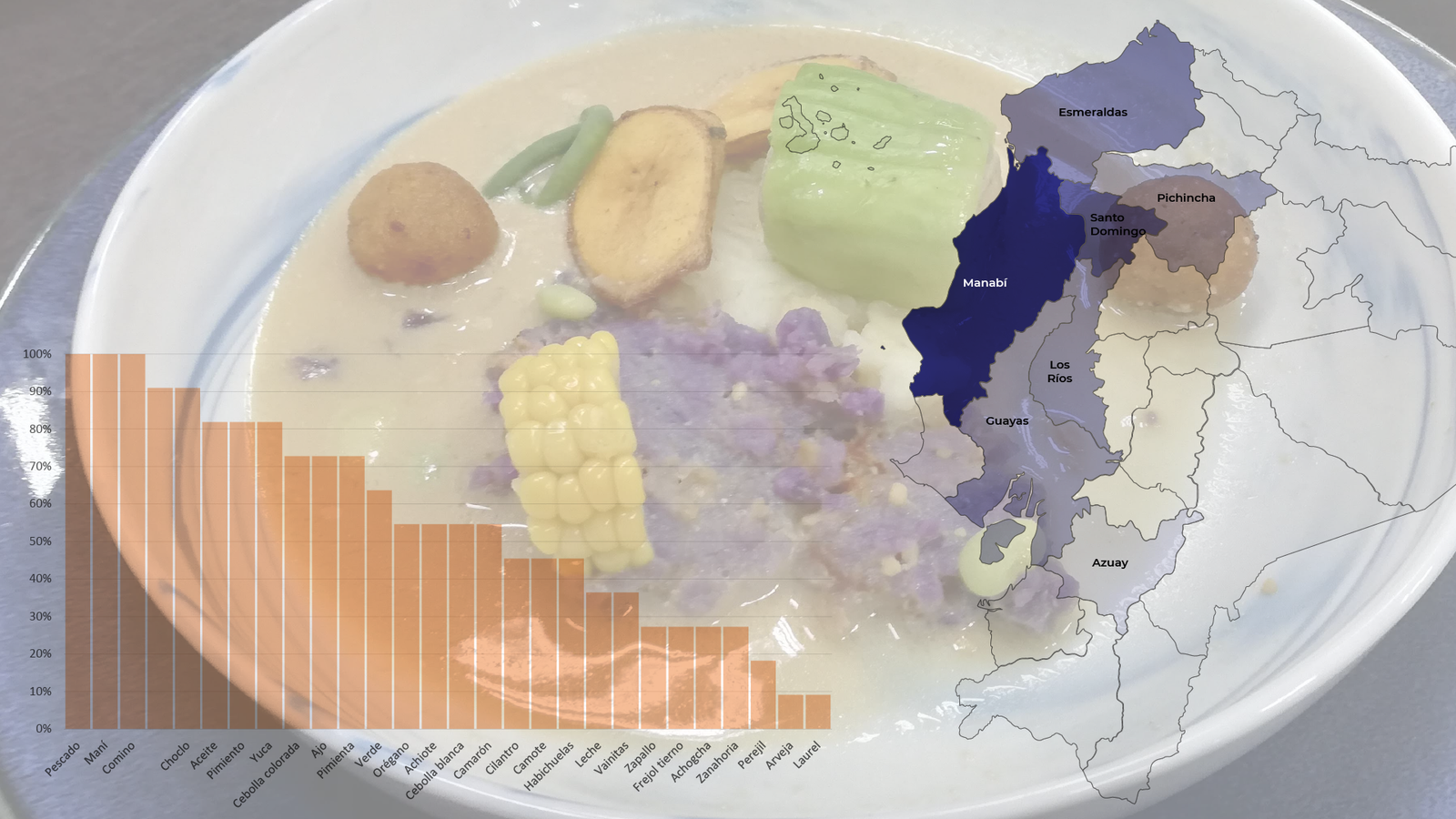
Viche is the most representative soup in the Ecuadorian province of Manabí. There is no clear documentation about its origin and composition, but there is consensus about its consistency and main ingredients. This study explores the web search behavior of the last nineteen years and reviews the ingredients listed in recipes published on the web. The highest interest is seen in Manabí province, followed by Santo Domingo de los Tsáchilas, Esmeraldas, Los Ríos, Guayas, Pichincha and Azuay. A yearly analysis shows three interest peaks in early January, Easter and mid-August, coinciding with times of high visitor influx and supporting the assertion that Viche displaces Fanesca as the traditional Easter soup in Manabí, but only in the cities of Portoviejo and Manta. Recipes available in the web have an average of 18 ingredients, with seven main ingredients, led by peanut, fish, cumin, plantain and corn, sixteen middle frequency ingredients and three low-frequency ingredients. Viche is confirmed as a primordially Manabita dish, with festive and ritual presence beside the day to day presence, and without authoritative presence in the web.
Downloads
References
Armendaris, M. (2014). Sabores: La nueva cocina del Ecuador. Plan Nacional para el desarrollo de Cocinas Patrimoniales del Ecuador.
Ávila Paredes, R. (2018). La fanesca. Antropología de la culinaria ritual ecuatoriana. http://repositorio.flacsoandes.edu.ec/handle/10469/13813
Davidson, A., & Jaine, T. (2006). The Oxford companion to food (2nd ed). Oxford University Press. DOI: https://doi.org/10.1093/acref/9780192806819.001.0001
Dorpenyo, I. K. (2022). Local Knowledge as Illiterate Rhetoric: An Antenarrative Approach to Enacting Socially Just Technical Communication. Journal of Technical Writing and Communication, 52(3), 291–315. https://doi.org/10.1177/00472816211030199 DOI: https://doi.org/10.1177/00472816211030199
Duarte-Casar, R. (2022). Ají Manabita o Ají Manaba: Presencia en Redes del Condimento de una Provincia. Revista de Gastronomía y Cocina, 1(1), Art. 1. https://doi.org/10.5281/zenodo.7497028 DOI: https://doi.org/10.70221/021220
Duarte-Casar, R., Robalino-Vallejo, J., Buzetta-Ricaurte, M. F., & Rojas-Le-Fort, M. (2022). Toward a characterization of Ecuadorian ceviche: Much more than shrimp. Journal of Ethnic Foods, 9(1), 1–12. https://doi.org/10.1186/s42779-022-00131-w DOI: https://doi.org/10.1186/s42779-022-00131-w
Ekmeiro-Salvador, J. E., Moreno-Rojas, R., Duerto-López, J. R., & Mata-Aristimuño, J. (2022). Estandarización de la receta y valoración nutricional del Cuajado, platillo típico del Oriente venezolano. Estudios Sociales. Revista de Alimentación Contemporánea y Desarrollo Regional. https://doi.org/10.24836/es.v32i59.1197 DOI: https://doi.org/10.24836/es.v32i59.1197
El Diario. (2019, abril 18). Viche vs Fanesca: Dos platos que dan sabor a la Semana Santa. El Diario Ecuador. https://www.eldiario.ec/noticias-manabi-ecuador/500057-viche-vs-fanesca-dos-platos-que-dan-sabor-a-la-semana-santa/
Gallardo, C. (2012). Ecuador Culinario. Udla.
Google. (s. f.). Google Trends. Google Trends. Recuperado 23 de mayo de 2022, de https://trends.google.com/trends/explore?date=all&q=ceviche
INPC. (2020). Calendario Festivo del Patrimonio Cultural Inmaterial Nacional—Costa. https://www.patrimoniocultural.gob.ec/9722-2/
Mathieu, N. del C. (1982). Esclavos negros en Cartagena y sus aportes léxicos. Instituto Caro y Cuervo.
Mavragani, A., Ochoa, G., & Tsagarakis, K. P. (2018). Assessing the Methods, Tools, and Statistical Approaches in Google Trends Research: Systematic Review. Journal of Medical Internet Research, 20(11), e270. https://doi.org/10.2196/jmir.9366 DOI: https://doi.org/10.2196/jmir.9366
Ministerio de Cultura de Colombia. (2021). Aprobada la Ley del Viche. https://www.mincultura.gov.co/prensa/noticias/Paginas/Aprobada-la-Ley-del-Viche.aspx
Mintur. (2018). Mapa Gastronómico del Ecuador. MINTUR Ecuador.
Özdemi̇r, S. S., & Uçuk, C. (2022). Is the Modern or Classical Presentation of Turkish Cuisine More Acceptable? A Study on the Visual Senses of Europeans. Journal of Tourismology, 8(2), Art. 2. https://doi.org/10.26650/jot.2022.8.2.1148129 DOI: https://doi.org/10.26650/jot.2022.8.2.1148129
Pazos Barrera, J. (2021). Elogio de las cocinas tradicionales del Ecuador. Pontificia Universidad Católica del Ecuador.
Regalado-Espinoza, L. (2019). Manabí y su comida milenaria (2a ed.). Ediciones ULEAM.
Rovetta, A. (2021). Reliability of Google Trends: Analysis of the Limits and Potential of Web Infoveillance During COVID-19 Pandemic and for Future Research. Frontiers in Research Metrics and Analytics, 6, 670226. https://doi.org/10.3389/frma.2021.670226 DOI: https://doi.org/10.3389/frma.2021.670226
Ugarte, C. A. G., Pionce, M. S. P., & Villafuerte, L. S. A. (2019). Los atractivos turísticos y su impacto en el perfil costero de Manabí—Ecuador. SATHIRI, 14(1), Art. 1. https://doi.org/10.32645/13906925.814 DOI: https://doi.org/10.32645/13906925.814
Unigarro-Solarte, C. (2010). Patrimonio cultural alimentario. Ministerio de Cultura del Ecuador.
Vidal-González, P., Medrano-Ábalos, P., & Sáez Álvarez, E. J. (2022). A nightmare glocal discussion. What are the ingredients of Paella Valenciana? International Journal of Gastronomy and Food Science, 27, 100430. https://doi.org/10.1016/j.ijgfs.2021.100430 DOI: https://doi.org/10.1016/j.ijgfs.2021.100430
Yagci, N., Sünkler, S., Häußler, H., & Lewandowski, D. (2022). A Comparison of Source Distribution and Result Overlap in Web Search Engines. Proceedings of the Association for Information Science and Technology, 59(1), 346–357. https://doi.org/10.1002/pra2.758 DOI: https://doi.org/10.1002/pra2.758
Yun, M.-O., & Mun, H.-G. (2004). Analysis of recipes for Korean foods in web sites. Journal of the Korean Dietetic Association, 10(4), 390–400.
Downloads
Published
License
Copyright (c) 2023 Rodrigo Duarte-Casar, Rodrigo Intriago-Valarezo, Fernanda Buzetta-Ricaurte, Marlene Rojas-Le-Fort

This work is licensed under a Creative Commons Attribution 4.0 International License.
You are free to:
Share — copy and redistribute the material in any medium or format
Adapt — remix, transform, and build upon the material for any purpose, even commercially. The licensor cannot revoke these freedoms as long as you follow the license terms.
Under the following terms:
Attribution — You must give appropriate credit, provide a link to the license, and indicate if changes have been made. You may do so in any reasonable manner, but not in any way that suggests the licensor endorses you or your use.
No additional restrictions — You may not apply legal terms or technological measures that legally restrict others from doing anything the license permits.